Tuesday, February 20, 2018

Solo Show opening in March in Beacon


Solo show, Prints and Ghosts, from March 10–April 8 at Theo Ganz Studio in Beacon. The opening reception will be on March 10 from 6–8 PM.

This exhibition will feature mixed-media monotype explorations of animals. The show includes an exciting new series which deals with variations on single themes and how they both relate to and diverge from one another.

Many of the prints were created using similar watercolor monotype techniques described on this blog here.

Saturday, March 18, 2017

Monoprint, Monotype, Strappo E-Zine

MM&S E-Zine
My work was included in the latest issue of MM&S e-zine along with some truly great printmakers. I feel privileged to have work in the same publication as these talented artists. 

Sunday, January 22, 2017

Monotype Print at Sacred Gallery Show

From Russia, With Love, Monotype
© Elana Goren
Trumpocolypse: What Now? at the Sacred Gallery in NYC has extended their show until the end of January. The opening was on Jan 20 as a counter-event to the Inauguration in DC. I have a couple of pieces in this show, one of which, a monotype, is shown above. Please visit this really great show of political art from very talented artists.

Sunday, January 15, 2017

Protest Posters - Free Downloads

Protest poster for Women's March
This protest poster, among others, has been made available for free download on my website at http://elanagoren.com/downloads.html.  Please feel free to use this if you need a sign and plan to protest at the Women's March in DC (or other city/town) on January 21.  Here's another available for free download that was popular on facebook:

Protest poster for Women's March

Saturday, December 24, 2016

Protest Posters--UPDATED

Protest Crude Disasters, Linocut
© Elana Goren
UPDATE: This is what the final linocut looks like. I omitted the oil pipeline from Orange Julius' head since I thought it was too weird and distracting. The linocut is on display at Trumpocolypse: What Now? at the Sacred Gallery in NYC and there is a high-res, downloadable, digital version at elanagoren.com. Thanks to Blond Jenny who posted some shots of the opening on the Sacred Gallery facebook page: https://www.facebook.com/pages/Sacred-Gallery/126499077405905
_______________________________________________________

This is the initial plan for a 18" x 24" woodcut poster that I may be carrying at the Women's March on January 21, 2017. I'm also working on a more woman-oriented one that might be more appropriate. I can save this one for a more general and/or environmental protest. I'll be working on this for the next couple of weeks. This will be one side of the poster.

The other side will be this:
Silkscreened on foam core. Two very different styles, I know, but without access to silkscreen facilities for the next few weeks, I opted to do a woodcut which I can print in my studio.

Saturday, February 13, 2016

Solo Show at the Paramount in Peekskill, NY

I was asked on Tuesday to exhibit my work at the Paramount Hudson Valley theater gallery. The thing is, they wanted the show up by today. So, basically, I pulled together a solo show, designed the posters and helped hang the show in two days. The framed work was packed, delivered and hung by late Friday afternoon and the posters were also printed by then. I have honestly never pulled a show together this fast. Whew!

Monday, January 18, 2016

Quote from MLK

I've been helping Farm Sanctuary, creating graphics for them to use on social media. This great Martin Luther King quote was posted today on Facebook by Gene Baur who is the founder of Farm Sanctuary:


Reflecting on one of my favorite #MLK quotes for some #MondayMotivation.
Posted by Gene Baur on Monday, January 18, 2016

Tuesday, October 27, 2015

Tracey and Jon Stewart and Farm Animal Rescue

article link: http://talkingpointsmemo.com/livewire/jon-stewart-tracey-farm-sanctuary

I was at an event last Saturday where Tracey and Jon Stewart were being honored for opening up a new sanctuary for rescued farm animals. The new sanctuary will be an extension of the Farm Sanctuary in Watkins Glen, NY.

The video below says far more than I can about the extraordinary work that the Farm Sanctuary and other NY sanctuaries (ie, Woodstock Farm Animal Sanctuary). Warning: the video below shows the horrid conditions that these 200 animals were rescued from.


Saturday, September 26, 2015

Gallery talk this Thursday, Oct 1

Dark Side of the Road, etching, 2014 ©Elana Goren
I will be giving an artist talk with fellow artist, Jackie Skrzynski, at the Theo Ganz Gallery in Beacon, NY from 7 – 8 pm. We will be discussing our work in the show that is up in the gallery now. Above is one of my etchings in the show.

Friday, March 20, 2015

White Ground Plate/Print Comparison

Left: zinc etching plate with white ground applied.
Right: etching print, 1st state.
Jacob Sheep
, etching © 2015, Elana Goren.
I have reviewed white ground etching techniques previously here and here. You should be able to get a good idea of the white ground process from the these links (previous posts), especially the first one.

I am always fascinated with the way a plate looks when prepared for etching versus the actual etching print from the same etched plate. This especially holds true for white ground etching techniques since the white ground mimics the white areas of the final print and more clearly resembles the actual light to dark areas in the image than other etching techniques do. This is because the thicker the white ground is on the plate, the whiter that area will be since the acid has more difficulty reaching the plate in those thicker areas. The acid discriminately etches the plate depending on how thick the white ground coverage is on any particular place on the plate. So, in the thinner areas, you see less white on the plate (a darker tone within the ground coverage) and the acid has a better chance to reach the plate for the etch.

The interesting thing is that as much as you can know that thicker is whiter and thinner is darker, you can never really know how the plate will etch, and surprises reveal themselves all the time. There will be areas that seem well protected and will therefore be lighter and other areas that seem less protected and should be darker. But as said before, surprises abound.

When I worked on the plate pictured above, I expected the sheep in the background as well as the area around it in the deep background to be darker than they actually turned out to be. The foreground sheep's darker areas (especially in the face) served up some unexpected lighter areas as were also seen on it's back.

After I took the photo of the 1st state of the etching (print seen above), I decided to go back and etch the plate again to tone back the background more. I used a combination of white ground and hard ground, since the former better blends with the similar effects from the 1st state and latter completely protects the areas that I don't want to be etched at all. The result (2nd state) is seen below. I still want to darken the background areas further. So I will either try to achieve it that while inking the plate and leaving more ink in the darker areas (wiping less there) or I will go back for a third state etch and try to get desired results that way.
Jacob Sheep, white ground etching, 2nd State.
© 2015, Elana Goren.

Thursday, March 5, 2015

William Hogarth and his "Four Stages of Cruelty"


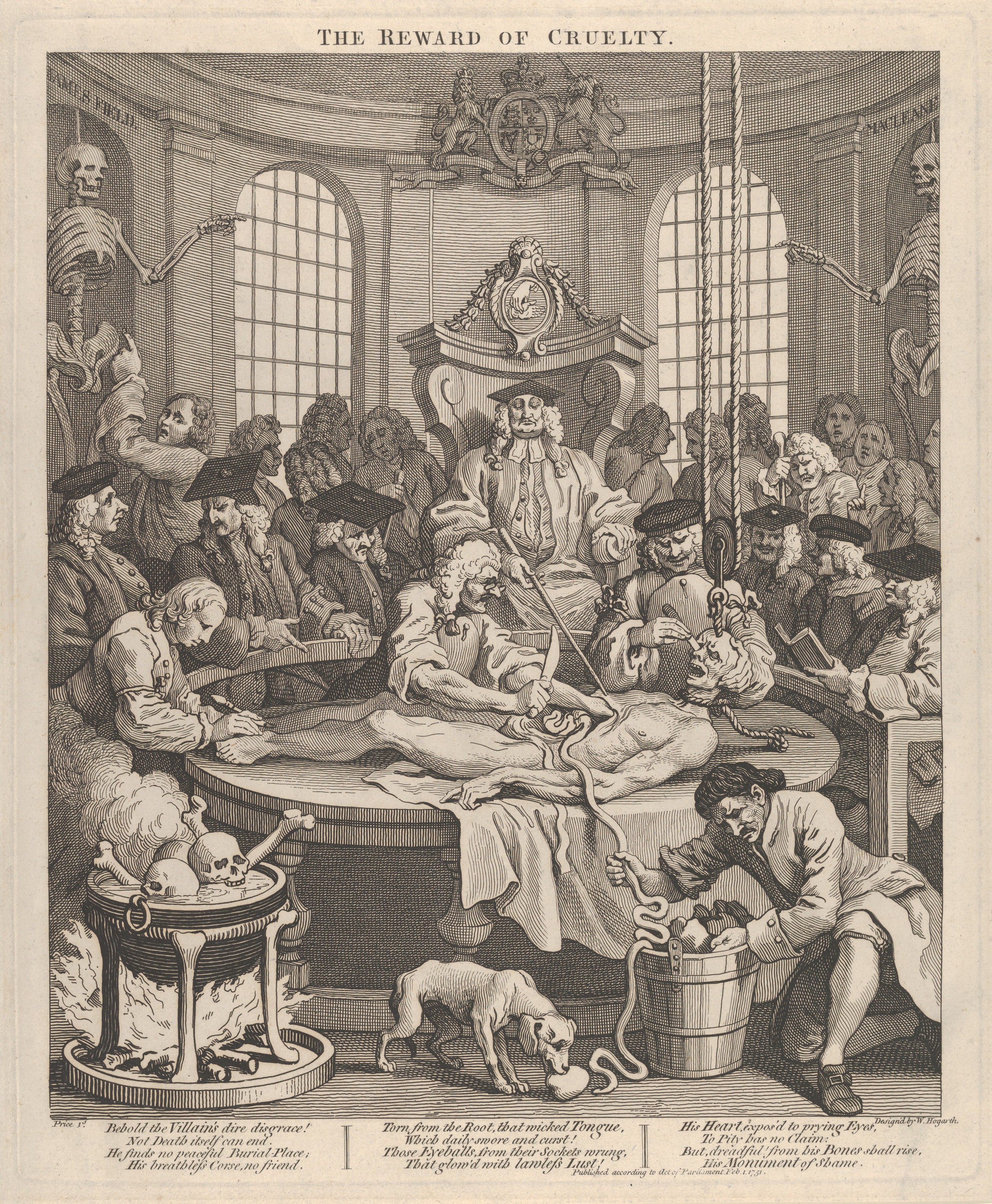
“The Reward of Cruelty” by William Hogarth
There is a great post up over at Our Hen House about William Hogarth's prints (engravings) as protest against cruelty. His series, Four Stages of Cruelty, depicts the connection of cruelty towards non-humans to cruelty towards fellow humans in societal problems and norms.

The post considers activism within the artistic community both historically and contemporarily. This interests me greatly as I am guided by my own morals and activism when creating my artwork, as returning visitors to this blog must surely know.

Friday, January 2, 2015

Mixed Media Monotypes

'Hit' mixed media and ink monotype.
©2014, Elana Goren. All Rights Reserved.
I've been doing alot of drawing on top of some of my water-media monotypes. The one pictured above used the monotype technique described here and here as well as here, but I used a non-waterproof calligraphy ink instead of watercolor and pigments.

Conte crayons, charcoal and pastels work really well as drawing mediums on top of monotypes whether they are oil or water-based. Using these mediums adds another dimension to your print and allows the flexibility to enhance or change the initial drawing that is part of the monotype.

Please see previous posts for reference about how to create water-media (watercolor) based monotypes.

Sunday, November 2, 2014

Not My Usual Post

Cup and Saucer Vine bud(s)
Photo was taken Nov. 1, 2014
File this post under:
This is completely unrelated to printmaking but something I wanted to share just the same...
__________________________________________________________________________

I am not the most experienced or accomplished gardener, but this year I had some successes with seeds planted last March, indoors on a make-shift, grow-light shelving unit that I set up for seed starting. The frost-free dates in my area are in mid-May and if I wait that long to plant seeds, it will be frosty again before I see alot of the plants mature.

The photos shown are of cup and saucer vines planted from seed, indoors in March. Even with their early starts this year, they didn't flower until early October. This may be because my gardening skills are lacking or maybe it's normal for the plant to take so long to mature enough to flower, but when it did finally flower, it did so spectacularly. And it nicely covers my deck railing bringing a natural softness to the straight lines of the wood slats. I planted it as a hummingbird plant but since the flowers bloomed after the hummingbirds were long gone, it ended up being a mid-Fall late bloomer after all the other (perennial) plants were way past their blooming times.

The other annual plants that I have for the hummingbirds are still flowering: Cigar plant, Butterfly Deep Pink Pentas and a Bahama Firebush. These were all potted and brought inside with hopes of successfully overwintering them indoors while the snow falls outside. While they were outside living on my deck and in my side garden, they fed the hummingbirds so well, that the birds were fighting over the garden on a daily basis.

Here are a couple of more photos (below) of my Cup and Saucer Vine. I shot these yesterday, worried that if I waited any longer, the impending freeze that will visit us any day now will kill the plant before I have a photographic record of it's beauty.

Cup and Saucer Vine
Cup and Saucer Vine

Monday, October 13, 2014

Upcoming shows

Dark Side of the Road
Aquatint Etching, © Elana Goren
My etchings will be in a couple of upcoming shows in October and November:

October 26 - November 8, 2014
NY Society of Etchers
Intaglio Prints New York/Melbourne
Reception: October 30, 6-8 PM
National Arts Club
15 Gramercy Park South
New York, NY

October 29 - December 10, 2014
SIPMA Juried Exhibition
"I Live Here"
Reception: October 29, 4:30-7:30 pm
Harold B. Lemmerman Gallery
New Jersey City University, NJ

See the calendar side bar on the right for more info.

Tuesday, October 7, 2014

Big Steamroller Printing Day on Sunday

This past Sunday, October 5, was the day that the steamroller project came to its ultimate conclusion—the printing of the huge woodcut blocks with a steamroller.  It was a beautiful day in Garrison, NY and we had a great turnout. There are some really wonderful (and nicer than seen here) photos of the event on the Garrison Art Center Facebook page and a really nice photo essay on this blog (link).

My plates went first and there were logistics that had to be worked out after mine and another set of plates were printed unevenly. After that, they rotated the direction of plates in relation to the steamroller drum which yielded better results. So, they very generously offered to print my plates again at the end of the session so that my 2nd print would benefit from the kinks having been worked out after the first printings.

Below is a step-by-step photo sequence that explains how the printing was done:
Here are some of the blocks waiting to be printed.

Inking up the plates with a huge roller.
Cutting the vinyl blanket to size before it's put over the underboard.

These are my 3 inked plates (triptych) side-by-side
on top of the vinyl blanket and the underboard.

Laying the proofing paper over the plates.
The top blanket layer goes over the paper.

The top MDF board covers the layers of
blankets, plate and paper.

Sweeping the dust and dirt from the roller drum.
Driving over the boards to print the plate sandwiched
between top and bottom boards, blankets.
Pulling the proof after printing.
Head Trap, Woodcut, 96" x 48" (8' x 4')
The second print had better ink coverage. Some areas were over-inked but overall it was pretty cool having a print this size.

Wednesday, September 17, 2014

Steamroller Project Work-In-Progress

Initial sketches (in book) and further sketch for the three 32" x 48" panels
I've been working away on the woodcut project for Garrison Art Center's Rolling on the River event. Above you can see the initial sketches that I was working with to create the composition that I am using for reference to carve the images.

I have three 32" x 48" panels which will form a 4' x 8' triptych print. The composition was designed so that each panel could stand alone as well as work in combination with the other panels to form a larger unified image. This was done partially for logistical reasons (fitting the panels in my car as well as easing the ability to hand-print later on—if I wish to—when I won't have a steam roller on hand).

Below, are images of the middle and left panels on the floor with my sketch reference handy to guide me as I carve the image into the wood. The wood that I am using is 1/2" birch plywood.

The bottom pic is of the right panel with ink applied so I could see the image more clearly and add details and refinements with more clarity. I'm still working on this but it gives me an idea of how the other panels will look and where I need to modify my approach as the image comes together.

Sketch reference on top of middle and left panel. Carving in-progress.

Right panel with ink applied so that I can see the image more clearly. Still working on details but the cow image is emerging.

Tuesday, August 12, 2014

Steamroller Printmaking

Though I realize that this blog has been very quiet of late, relying on old posts about watercolor monotypes and other intriguing techniques to satisfy visitors' need for information, I am now trying to get back to a (semi) regular posting schedule.

I have some news about a new woodcut project and I hope to document my experience and post this on the blog in the next month. I have been asked to participate in the Garrison Art Center's Rollin' on the River event where large-scale woodcuts will be printed using a steamroller. While this is certainly not a new thing in the printmaking world, it is something that is new to me as I have never worked on this scale before. I am working on a plywood plate that is about 4 feet x 8 feet which will then be printed on the event day, October 5, via steamroller. This event will help celebrate the Garrison Art Center's 50th anniversary.

Tuesday, January 14, 2014

More on Watercolor Monotypes

Left: BP's Legacy, mixed media monotype © 2014 Elana Goren
Right: Two examples of watercolor monotype plates with pigment reactions
I've discussed watercolor monotypes using pigments on this blog here and here. This post is a continuation of the discussion I started on my previous posts. And I would like to add to these previous discussions that if you would like to experiment with watercolor monotypes, you should use a new piece of plexiglass and not one that has been used previously for traditional oil-based monotypes. This is because any residual oil from an old plate will repel your attempts at applying watercolor/water media to your plate. I strongly suggest that once you have supplied yourself with a new watercolor plate, label it as such and reuse it only for watercolor/water-based media monotypes.

As for my work, I have been doing alot of experimentation with the abstract qualities of watercolor reactions on a plexiglass plate especially while working with the way pigments react to each other. I've noticed that blue pigments seem to like to repel others and this makes for interesting patterns that emerge on a plexiglass while the watercolor dries. But as I mentioned in a previous post, you need to experiment with different pigments and see for yourself what kind of results you can come with.

I have increasingly been interested in layering my color and using the watercolor abstractions as a base or (underpainting) for adding layers of color to create depth and atmosphere. It is difficult (not impossible) to layer watercolor monotypes over previously printed watercolor since you need to wet the paper before you print and this can destroy or very much weaken the image that was first printed on it. So, I decided to start printing oil-based monotypes over the watercolor base and layer my color that way. For oil-based monotypes, you do not have to wet the paper in order to print (though if you are doing an oil-based monotype on a fresh sheet of paper, wetting it will make it print better). 

Printing over watercolor on dry paper is tricky. You do not want your ink to be too stiff or tacky or it will not print cleanly and might even take some of the top layer of paper off in the dryer areas. I have been using a mixture of pigment, etching ink and block printing ink (trans base) to create my oil-based colors; a mixture that has been working pretty well. I had started by using litho inks but these are really too stiff for this layering process since they work best with damp paper.

The print on the left at the top of this post, was created with a base layer from a watercolor monotype that was a bright blue mixed with some rust colors similar to the plates shown to the right of it. I started to layer oil-based colors using some of the same pigments but obviously using reds and yellows more heavily. The fish skeleton is a linocut (relief) print. What I found interesting is that the blue pigment in the watercolor underlayer came through all of my consecutive print layers as shown in the two details below.
BPs Legacy, Detail

BPs Legacy, Detail 2


Saturday, December 7, 2013

Carrier Pigeon Show in Chelsea (NYC)


My work is in a group show at the EMOA Space in Chelsea on 530 w. 25th street, NYC. Please stop by if you are in the NY area. It's a great show featuring the talented artists who have contributed to Carrier Pigeon Magazine. The show runs until December 14, 2013.