Showing posts with label sheep. Show all posts

Friday, March 20, 2015

White Ground Plate/Print Comparison

Left: zinc etching plate with white ground applied.
Right: etching print, 1st state.
Jacob Sheep
, etching © 2015, Elana Goren.
I have reviewed white ground etching techniques previously here and here. You should be able to get a good idea of the white ground process from the these links (previous posts), especially the first one.

I am always fascinated with the way a plate looks when prepared for etching versus the actual etching print from the same etched plate. This especially holds true for white ground etching techniques since the white ground mimics the white areas of the final print and more clearly resembles the actual light to dark areas in the image than other etching techniques do. This is because the thicker the white ground is on the plate, the whiter that area will be since the acid has more difficulty reaching the plate in those thicker areas. The acid discriminately etches the plate depending on how thick the white ground coverage is on any particular place on the plate. So, in the thinner areas, you see less white on the plate (a darker tone within the ground coverage) and the acid has a better chance to reach the plate for the etch.

The interesting thing is that as much as you can know that thicker is whiter and thinner is darker, you can never really know how the plate will etch, and surprises reveal themselves all the time. There will be areas that seem well protected and will therefore be lighter and other areas that seem less protected and should be darker. But as said before, surprises abound.

When I worked on the plate pictured above, I expected the sheep in the background as well as the area around it in the deep background to be darker than they actually turned out to be. The foreground sheep's darker areas (especially in the face) served up some unexpected lighter areas as were also seen on it's back.

After I took the photo of the 1st state of the etching (print seen above), I decided to go back and etch the plate again to tone back the background more. I used a combination of white ground and hard ground, since the former better blends with the similar effects from the 1st state and latter completely protects the areas that I don't want to be etched at all. The result (2nd state) is seen below. I still want to darken the background areas further. So I will either try to achieve it that while inking the plate and leaving more ink in the darker areas (wiping less there) or I will go back for a third state etch and try to get desired results that way.
Jacob Sheep, white ground etching, 2nd State.
© 2015, Elana Goren.

Friday, January 2, 2015

Mixed Media Monotypes

'Hit' mixed media and ink monotype.
©2014, Elana Goren. All Rights Reserved.
I've been doing alot of drawing on top of some of my water-media monotypes. The one pictured above used the monotype technique described here and here as well as here, but I used a non-waterproof calligraphy ink instead of watercolor and pigments.

Conte crayons, charcoal and pastels work really well as drawing mediums on top of monotypes whether they are oil or water-based. Using these mediums adds another dimension to your print and allows the flexibility to enhance or change the initial drawing that is part of the monotype.

Please see previous posts for reference about how to create water-media (watercolor) based monotypes.

Thursday, April 4, 2013

Inspiration: Käthe Kollwitz

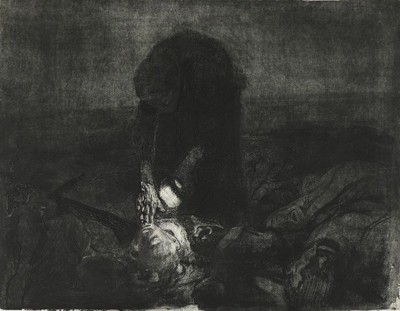
Käthe Kollwitz, Lithograph, Tod (Death), 1897
Käthe Kollwitz, Etching, After the Battle (Schlachtfeld), 1907
I recently took a stone lithography class with Devraj Dakoji at the Robert Blackburn Printmaking Workshop (RBPMW) and he has been (patiently) helping me print my stone from that class. I am very much a novice lithographer but I have been so inspired by the work of Käthe Kollwitz that I knew her work would act as a guide as I put litho crayon to stone.

Kollwitz's masterful use of shadow and light to evoke emotional responses to the plight of the people she depicts is as visually powerful today as it was over a hundred years ago. Her artistic subjects were derived from her world, what was going on around her: war, famine, disease and the gut-wrenching sorrow seen in the human condition during very difficult times.

I admire everything about Kollwitz's work: her ability to expertly render her subjects with empathy combined with a skillful hand, her expertise as a printmaker using the medium to maximize the dramatic and visceral reaction intended for the viewer, and her devotion to relaying the wrongs that she felt compelled to reveal through her art.

The two works above are a couple of my favorite pieces of Kollwitz's, especially the poignant etching, After the Battle, which by showing very little through use of a bit of light, speaks volumes about the poor woman on the battlefield searching for her loved one. I get chills and endless inspiration from this piece. Kollowitz's lithograph, Death, was my launching point for what I was trying to achieve with my own lithograph, The Road, shown below. I debated even showing my novice attempt at lithography but I thought it might be more relevant to a post about inspiration if I showed what the inspiration lead to.
So here is my humble and first lithographic homage to Käthe Kollwitz:

© 2013 Elana Goren
Lithograph, The Road


Saturday, June 19, 2010

New Woodcut

"Sundown"
Woodcut
Plate size: 13 1/4" x 12"

I am attempting to expand my printmaking focus and create more woodcut prints. One reason is that I love the way the wood grain comes through on the print. I also find the act of carving the wood very therapeutic, almost meditative. The wood also guides me, helping me with the direction that I take the work and I love aspect of the creative partnership with the medium.

I try to find discarded scrap wood, if possible, so that I can try to minimize my impact on the trees used for plywood, etc. It's not always easy or practical to do this but I think it's worth the effort to find scrap when and where I can.

I find that my approach to carving the wood is similar to my approach to creating aquatint etchings where I tend to use multiple strokes to add depth to the image. With etchings, I use a brush with stopout (both asphaltum-based and acrylic-based) to create the varied layers of tints. And with woodcuts, it seems natural to me to make the same type of marks with my carving tools. I'm not sure if this is the best approach to use for wood since it lends itself to yielding more bold and graphic prints than does etching. Yet, it seems that my style leans more towards the subtle and a focus on detail (unless I'm working on monotypes), so this comes through on my woodcut work as well as with my etchings.

Sunday, November 15, 2009

Jacob Ram


My solo show came down today and I thought that as a celebration of a successful run, I'd post a drawing from the show. This is a magnificent ram of the Jacob Sheep breed. I loved photographing and drawing him as well as his little son. His son was featured in a couple of previous posts here (with mother) and here (scroll down for photo).

Saturday, October 24, 2009

New Etching Series


I've been working on an etching series featuring animals being stalked by human shadows alluding to the deadly fate that they face daily in the human world.

By experimenting with textures and different acid resists I was able to achieve the eerie atmosphere in the prints that define the series.

This series was created with a mixture of effort to tap into my most gut-wrenching feelings about the plight of non-human animals in a human world as well as hints of satisfaction that I am finally dealing with political issues in my artwork that deeply matter to me.

It's not always easy to deal with deeply emotional and/or political issues when my muse is calling but again it's not very satisfying for me to skip lightly on the surface with little to say about what's down deep. I wonder how many other artists deal with this struggle.

UPDATE: The Huffington Post has been running a series of articles on a new book by Jonathan Safran Foer
called Eating Animals. As Huff Po contributor, Dr. Andrew Weil, puts it, "Foer makes it clear that factory farming is the exceptional human activity that debases and destroys everything it touches: land, people, communities, and most of all, the innocents at the nexus, animals."